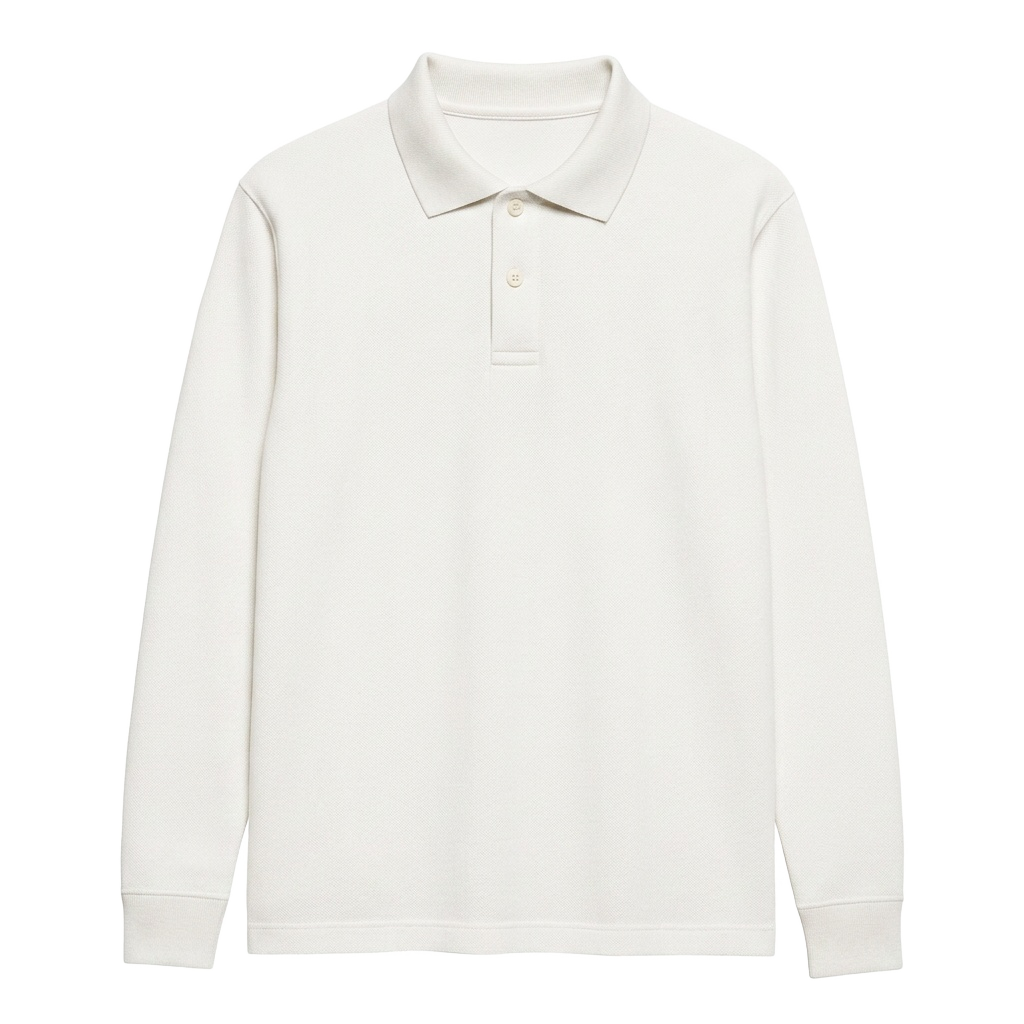
White Long Sleeve Polo Shirt
In 1926, René Lacoste — world number one tennis player, nicknamed The Crocodile — was frustrated with the long-sleeved button-down shirts players wore on court. He designed a short-sleeved shirt in lightweight piqué cotton with a soft ribbed collar that stayed down. He called it a chemise. Everyone else called it a polo shirt. Today it is worth $8 billion a year. The crocodile logo is still on the chest.
The same factories that produce for houses like Celine and Balenciaga can produce this piece, directly to you
GABI
Make it yours
Material gradeMOQ 30
Colour
White Long Sleeve Polo Shirt
In 1926, René Lacoste — world number one tennis player, nicknamed The Crocodile — was frustrated with the long-sleeved button-down shirts players wore on court. He designed a short-sleeved shirt in lightweight piqué cotton with a soft ribbed collar that stayed down. He called it a chemise. Everyone else called it a polo shirt. Today it is worth $8 billion a year. The crocodile logo is still on the chest.
The same factories that produce for houses like Celine and Balenciaga can produce this piece, directly to you
GABI
Make it yours
Material gradeMOQ 30
Colour
In 1926, René Lacoste — world number one tennis player, nicknamed The Crocodile — was frustrated with the long-sleeved button-down shirts players wore on court. He designed a short-sleeved shirt in lightweight piqué cotton with a soft ribbed collar that stayed down. He called it a chemise. Everyone else called it a polo shirt. Today it is worth $8 billion a year. The crocodile logo is still on the chest.
The Story of the Polo Shirt — "The Tennis Shirt That Conquered Everything"
The polo shirt was invented to solve a specific technical problem. It was not designed to be iconic. In the 1920s, tennis players wore long-sleeved Oxford cloth shirts with a full button placket. The shirts were stiff, heavy for athletic use, and the collar required starch to stay presentable — a constant irritation in a sport played at full stretch. René Lacoste designed a solution: a short-sleeved shirt in lightweight piqué cotton with a soft, unlined ribbed collar that lay flat under movement and a short placket with two or three buttons. The shirt had no tail — unlike dress shirts of the era — allowing it to be worn untucked without looking unfinished.
Lacoste wore the shirt at the 1926 US Open and began selling it under his own label in 1933 with a small embroidered crocodile — a reference to his nickname — on the left chest. The garment design patent and the concept of the branded sportswear logo were established simultaneously. There is no polo shirt without Lacoste.
The polo shirt crossed from tennis court to polo field through the 1930s and 1940s, where its breathability and freedom of movement suited the equestrian context. It moved from sport to leisure as the country club culture of mid-century America adopted it as the uniform of casual affluence. When Ralph Lauren named his label Polo in 1967 and placed the polo player emblem on his piqué shirt, he was making an explicit reference to this lineage — the garment's association with money, sport, and a certain kind of unhurried leisure.
The Lacoste and Ralph Lauren polo shirts defined different positions within the same garment. Lacoste's was sports heritage — cotton piqué, precise construction, the crocodile as a small but significant mark of provenance. Ralph Lauren's was aspirational Americana — the polo player, the colours of the Ivy League and the preppy tradition, available in dozens of colourways. Both understood that the collar was the defining element of the garment — the detail that separated the polo shirt from the T-shirt and made it appropriate across a broader range of social contexts.
The polo shirt's cultural trajectory through the late 20th century is one of the most promiscuous in fashion. It was the default garment of the British rave scene in the late 1980s and early 1990s, the football terrace subculture, the American preppy revival, and contemporary streetwear. It appeared in Supreme drops and Prada runway shows in the same year. This range of appropriation is possible because of the polo shirt's structural ambiguity — the collar signals formality, the knit construction signals casualness.
The piqué fabric that defines the polo shirt is a knit structure, not a woven one. Piqué uses a specialised knitting method that produces a raised, textured surface — the honeycomb or waffle pattern visible on every classic polo. The texture is structural, not applied, and increases breathability and moisture-wicking. This is the most commonly misunderstood technical fact about the garment.
The five piqué structures recognised in the Sparkit platform — PIQUE_COTTON, PIQUE_STRETCH, PIQUE_FINE_STRUCT, PIQUE_DOUBLE, and PIQUE_PERFORMANCE — represent the full commercial range from standard cotton to technical performance fabrics. Each sits at a different price point and serves a different function, from everyday wear to athletic performance to luxury knitwear.
The luxury polo shirt has become one of fashion's most reliable premium products. Loro Piana produces piqué polos in extra-fine merino, cashmere blends, and lotus fibre at prices above £500. Brunello Cucinelli's polo shirts are benchmarks for Italian artisanal manufacturing. The simplicity of the garment allows the entire premium to be concentrated in the fabric quality — where it belongs.
FAQ
Polo shirts take 30 to 102 days from order to UK delivery. Portugal and Turkey are 30 to 57 days. China is 57 to 87 days. Bangladesh is 65 to 102 days. Italy is 38 to 65 days. Production is generally faster than woven shirts due to simpler construction.
Polo shirts use HS code 6105 for men's/unisex and 6106 for women's knit garments. This differs from woven shirts (6205/6206) and reflects correct classification as knitwear. Misclassification can affect duty rates.
Yes. Garment dyeing is common at premium tier, producing a washed, tonal finish. The Sparkit Engine applies $1.15 per unit plus 10–15% CMT uplift. Cotton piqué works well. Performance piqué generally does not due to different dye chemistry.
PIQUE_FINE_STRUCT includes birdseye and jacquard piqué — finer, denser knit structures with a more refined texture. Used by luxury brands like Loro Piana and Brunello Cucinelli. Benchmark: ~$12/m premium, ~$28/m luxury. Best for elevated polos and merino blends.
A polo shirt costs between $15 and $70 per unit landed depending on fabric type, piqué structure, and factory region. An affordable PIQUE_COTTON solid polo from Bangladesh lands at approximately $15. A premium GOTS garment-dyed polo from Portugal lands at approximately $31. A luxury PIQUE_FINE_STRUCT merino blend polo from Italy lands at approximately $70. Polo shirts have lower landed costs than woven shirts at the same tier — primarily because fabric consumption is lower (0.90–1.10m vs 1.60m for a woven shirt) and CMT is simpler.
A polo shirt is a knit garment. Piqué — the fabric that defines the polo shirt — is produced on knitting machines, not weaving looms. The raised honeycomb or waffle texture of piqué is a knit structure formed by the loop formation process. This means polo shirts must go to a knit factory, not a woven shirt factory. This is the single most common routing error in polo shirt production.
Piqué is a weft-knit fabric that produces a raised, textured surface through a specialised knitting structure. The characteristic honeycomb or waffle texture is formed by the way yarn loops are formed and interlocked during knitting. The raised surface increases the fabric's total surface area, making it more breathable and more moisture-wicking than a flat jersey knit. The five Sparkit piqué material identifiers are: PIQUE_COTTON, PIQUE_STRETCH, PIQUE_FINE_STRUCT, PIQUE_DOUBLE, and PIQUE_PERFORMANCE.
The collar is the defining quality signal of a polo shirt — the detail that separates the polo from a T-shirt and determines whether the garment reads as quality or poor construction. A collar that curls, gaps, or loses its shape after washing signals poor manufacturing regardless of fabric cost. The collar must be cut on the correct grain, sewn with correct attachment tension, and finished with the correct rib weight. At luxury tier, woven poplin or self-piqué collars with soft interlining represent the highest specification.
PIQUE_COTTON is standard cotton with the classic honeycomb texture — breathable and versatile across casual to semi-formal contexts. PIQUE_PERFORMANCE is synthetic or blended (polyester, nylon) engineered for moisture management, quick drying, and shape retention under athletic use. Performance piqué is the standard for sport-focused polos and uses different dye chemistry (disperse dye) than cotton.
The Sparkit Engine supports four certification levels: conventional (×1.00), organic cotton non-GOTS (×1.15), GOTS (×1.23), and multiple certifications (×1.28). GOTS is the strongest organic certification for cotton piqué. For performance piqué, GRS (Global Recycled Standard) applies to recycled polyester. For merino blends, RWS (Responsible Wool Standard) is relevant. Always match certification to fibre type.
Standard MOQs range from 500–2,000 units in Bangladesh, 300–1,000 in China, and 100–300 in Portugal. Through the Sparkit network MOQs start at 50–100 units in Portugal and Italy, 100–200 in Turkey, 100–300 in China, and 200–400 in Bangladesh.
Standard logos use 500–1,500 stitches ($0.50–1.50/unit). Complex logos use 2,000–5,000 stitches ($1.50–3.00/unit). Always specify cutaway stabiliser — piqué fabric distorts under embroidery pressure. Reduce stitch density for fine piqué. Always test on production fabric before bulk.