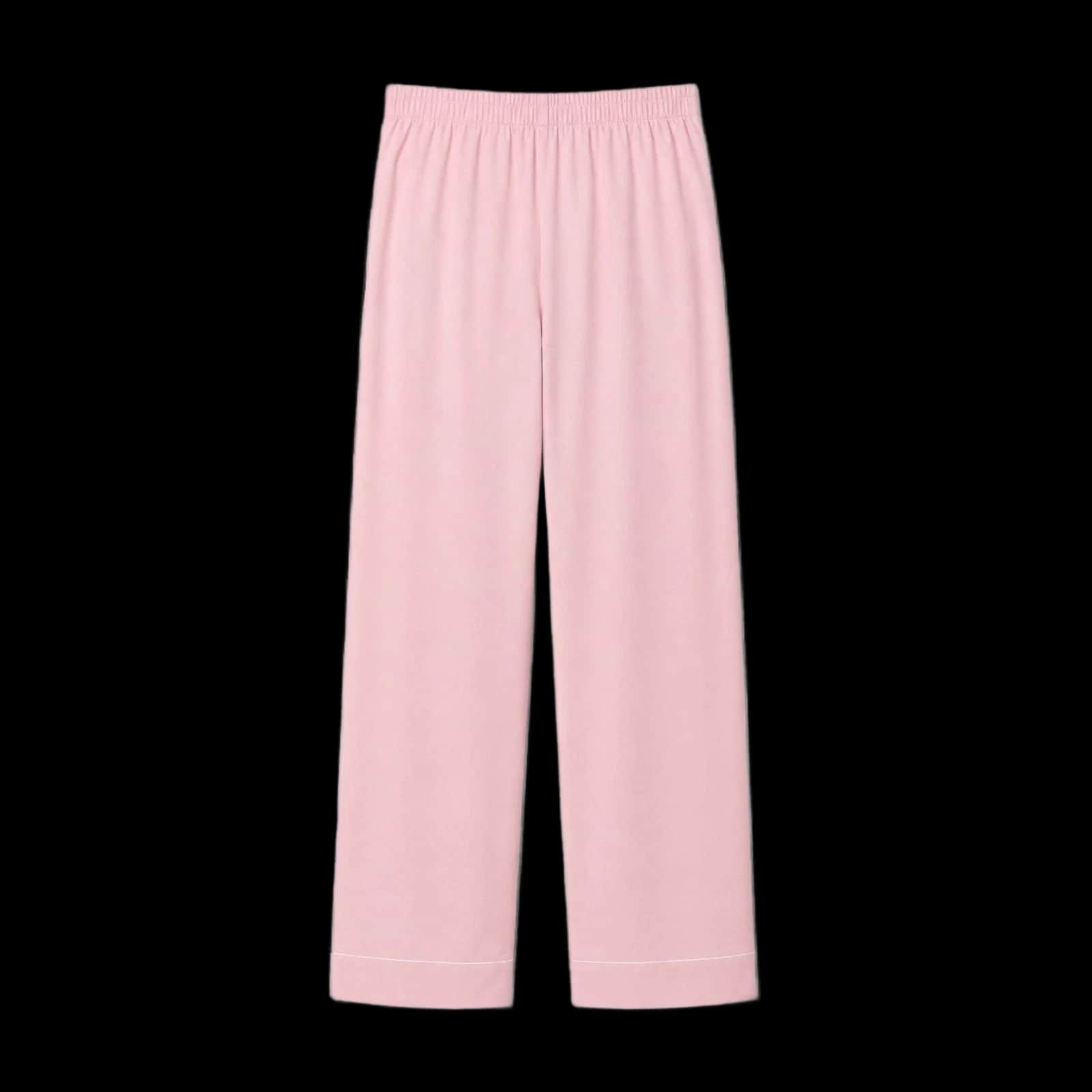
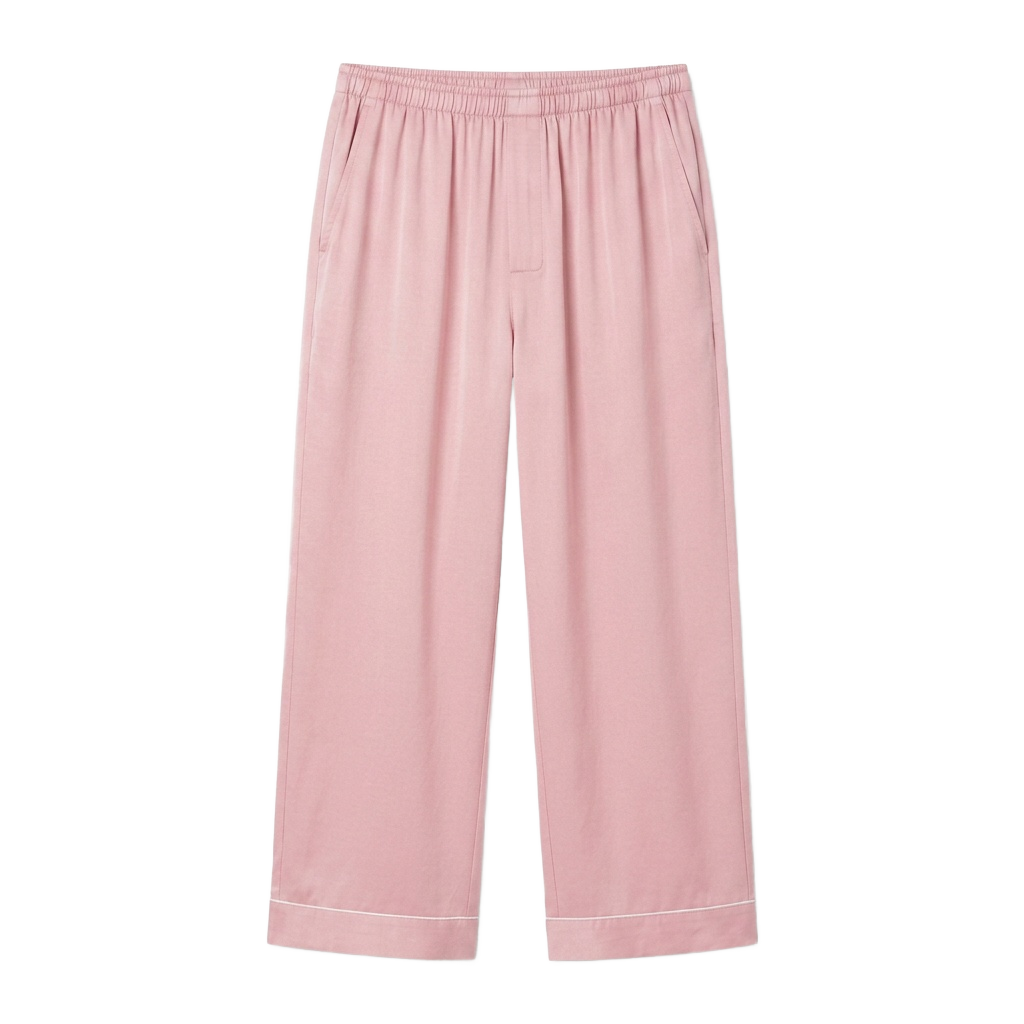
Sakura Pink Silk Wide-Leg Pants
These full-length pants fall straight from hip to hem with a wide, even leg opening. A gathered elastic waistband sits flat against the body, while the legs drop in a continuous line without tapering. Side seam pockets lie flush, and the straight hem is finished with a narrow contrast piping band.
The same factories that produce for houses like Celine and Balenciaga can produce this piece, directly to you
GABI
Make it yours
Material gradeMOQ 50
Colour
- Main Fabric: 100% Silk, 80gsm
- pocket bags: 100% Silk
- piping: 100% Cotton
- Hand wash cold
- Do not bleach
- Do not tumble dry
- Iron on a low setting
A guide based on the garment’s materials — always follow the care label on the item itself.
Coco Chanel started wearing her lovers clothes to bed in the 1920s and called it relaxed dressing. The pajama entered fashion from sleepwear. By the 1970s, Yves Saint Laurent had put a woman in a tuxedo-cut silk pajama suit and sent her to dinner. The pajama set is the only garment in the encyclopedia that travels from the bedroom to the street to the red carpet without changing its construction. The silk pajama shirt tucked into wide-leg trousers at a Milan dinner is made in exactly the same factory, on exactly the same machines, as the cotton poplin pajama set someone sleeps in on a Tuesday night in London. The only thing that changes is the fabric.
The Woven Pajama Set -- "The Only Garment That Goes from Bedroom to Red Carpet Without Changing Its Construction"
The pajama has its origin in South Asian dress. The word derives from the Hindi and Urdu paijama -- leg garment -- referring to the loose, drawstring-waist trousers worn across the Indian subcontinent. British colonial officers adopted the garment for sleeping in India and brought it back to England in the 19th century, where it became the standard sleepwear for men of a certain class. The pajama shirt was added later as a matched top, creating the two-piece set that remains the dominant commercial format today.
The fabric history of pajamas maps directly to the fabric history of the 20th century. Cotton poplin and lawn were the Victorian and Edwardian standards -- lightweight, breathable, easy to launder. Silk charmeuse pajamas became a marker of wealth and leisure in the 1920s and 1930s -- Chanel, Schiaparelli, and the Hollywood studios all played with the pajama as a vehicle for luxury and transgression. Brushed cotton and winceyette (a soft-finish cotton flannel) became the British winter standard in the mid-20th century, associated with warmth and domesticity. Polyester satin entered the mass market in the 1970s as a cheaper proxy for silk. Each of these fabric routes is still commercially active today.
The contemporary pajama set market has two distinct commercial poles. The first is the luxury and premium DTC market -- GOTS cotton poplin in seasonal prints, washed linen in neutral tones, silk charmeuse in simple colourways -- sold at $150-500 per set by brands including Sleeper, Desmond and Dempsey, and Pour Les Femmes. The second is the fashion sleepwear market -- satin sets in bold colours and prints, worn both as sleepwear and as going-out tops with tailored trousers -- sold at $60-150 per set across the high street and DTC channel.
For independent creators, the woven pajama set offers three specific commercial advantages. First, it is a gifting category -- the pajama set is purchased as a gift at a significantly higher rate than most apparel. Second, it has natural seasonal cadences (flannel for winter, linen for summer, satin for the gifting season) that drive repeat collections. Third, the print surface is large -- a long-sleeve shirt and full-length trouser in a distinctive print is a powerful brand statement that photographs exceptionally well.
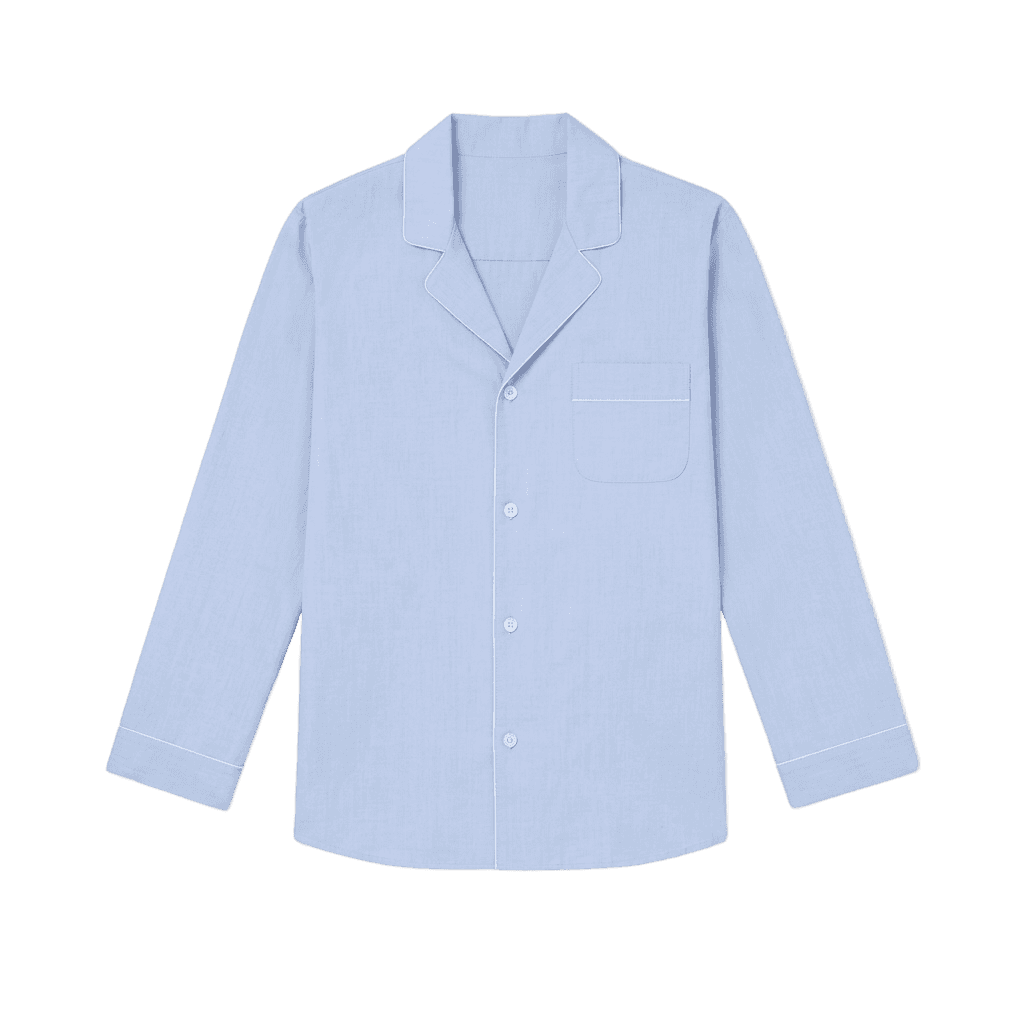
The piping detail -- a narrow contrast fabric cord sewn into seams at collar, cuff, and pocket -- is the quality signal that separates a premium pajama set from a basic one. It is a more complex CMT operation (the cord must be covered in bias-cut contrast fabric and inserted into the seam during construction), it requires a contrast fabric in addition to the face fabric, and it is immediately legible to the consumer as a crafted rather than commodity garment. For a DTC pajama set above $120, piping is the single highest-return-on-investment construction detail.
FAQ
A woven pajama set costs $44-251 landed depending on fabric. Cotton poplin plain set: ~$46 → $182 retail. GOTS printed poplin with piping: ~$80 → $280-$320. GOTS linen with contrast collar: ~$106 → $369. Polyester satin affordable: ~$44 → $175-$218. Silk charmeuse 19mm luxury: ~$251 → $754-$1,005. The fabric is the primary cost driver at premium and luxury tier.
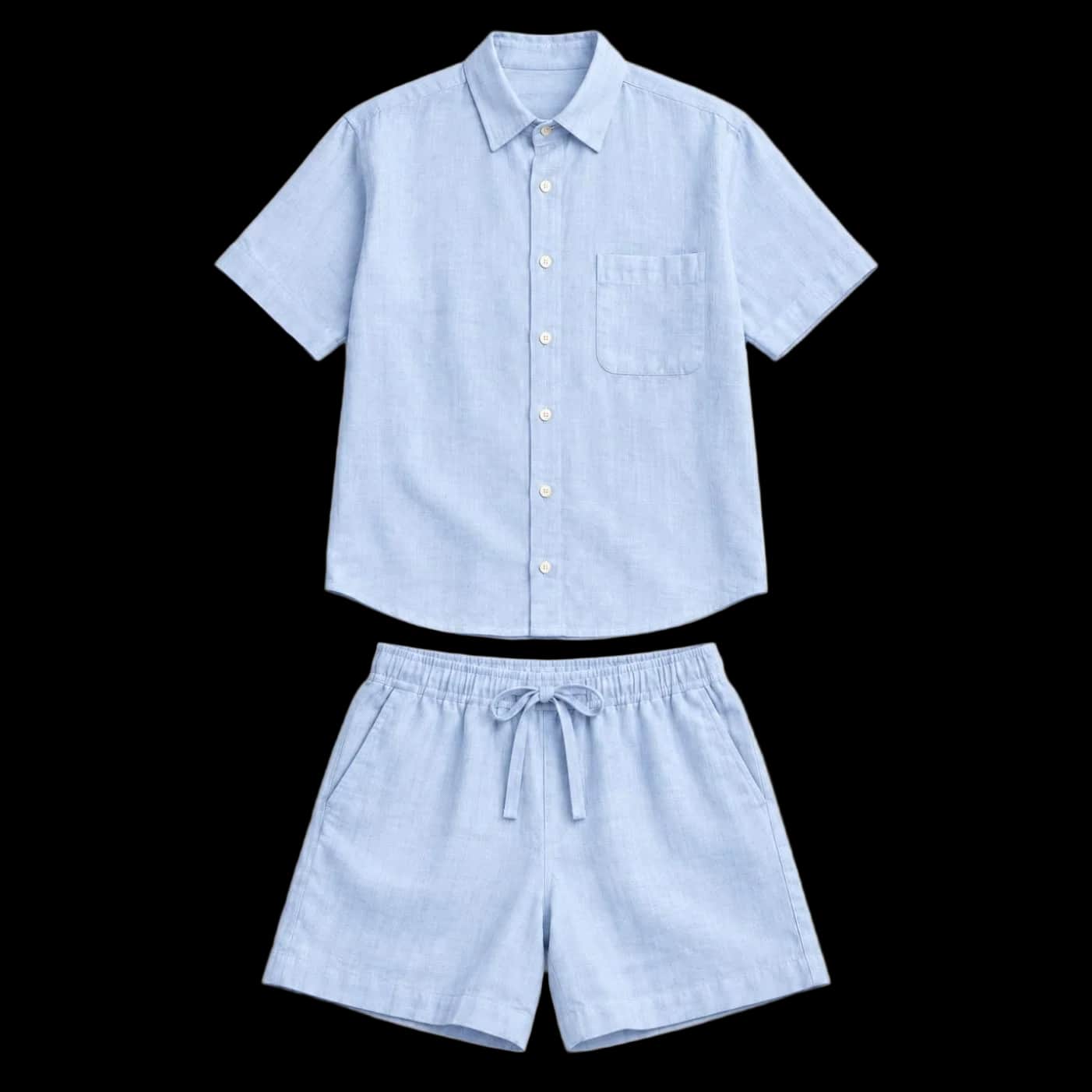
It depends on the season and positioning. Cotton poplin (GOTS): the commercial standard, breathable, prints beautifully, year-round, accessible. Linen: summer premium, gets softer with washing, strong sustainability story. Brushed cotton/flannel: autumn-winter, the softest sleep fabric at affordable-premium. Polyester satin: fashion sleepwear, bold colour, affordable, high social media performance. Silk charmeuse (16-19mm): true luxury, unmatched hand and drape, significant price premium.
Momme (mm) is the weight measure for silk -- equivalent to GSM for other fabrics but measured differently. 12-14mm is entry luxury (slightly sheer, summer). 16-19mm is the premium commercial standard -- the weight specified by Olivia von Halle, Sleeper, and Desmond and Dempsey. 20-22mm is heavy luxury with structure. Always specify Momme weight on the silk tech pack -- "silk" without a Momme specification is not a complete brief.
Piping is a narrow cord covered in bias-cut contrast fabric, inserted into seams at collar, cuffs, and breast pocket. It is the defining quality signal of a premium pajama set -- immediately legible to the consumer as a crafted rather than commodity garment. It adds $3.50-5.50 CMT per set and lifts retail positioning by $60-120. For any pajama set above $150 retail target, piping at four placements is the highest-return construction detail available.
Yes -- the woven pajama set uses the same factory infrastructure as the poplin shirt (#012), linen shirt (#014), and flannel shirt (#015). The pajama-specific operations are: waistband channel construction, piping insertion, and fabric handling for satin or silk. For satin and silk, confirm the factory has specific experience with these fabrics before brief submission -- slippery fabrics require different presser feet, tension settings, and cutting technique.
Silk charmeuse requires: Teflon or roller presser foot, reduced upper thread tension, tissue paper under seam line during sewing (tear away after), no water contact on face during production, acid dye only (reactive dye damages silk fibre), dry-clean or hand-wash cold care label. Confirm the factory has silk production experience. A standard poplin factory without silk experience will produce puckering and water spotting -- both are irreversible on silk fabric.
Brushed cotton (also called winceyette or flannelette) is a cotton fabric where the surface has been passed through a brushing machine -- rollers with fine wire teeth that raise a soft nap on the fabric surface. This nap traps air and provides warmth significantly above the fabric weight. It is the defining fabric of the autumn-winter pajama market. The brushing step is a specialist finishing process -- confirm the factory has a brushing machine before brief. Care label: 30C delicate wash, do not tumble dry.
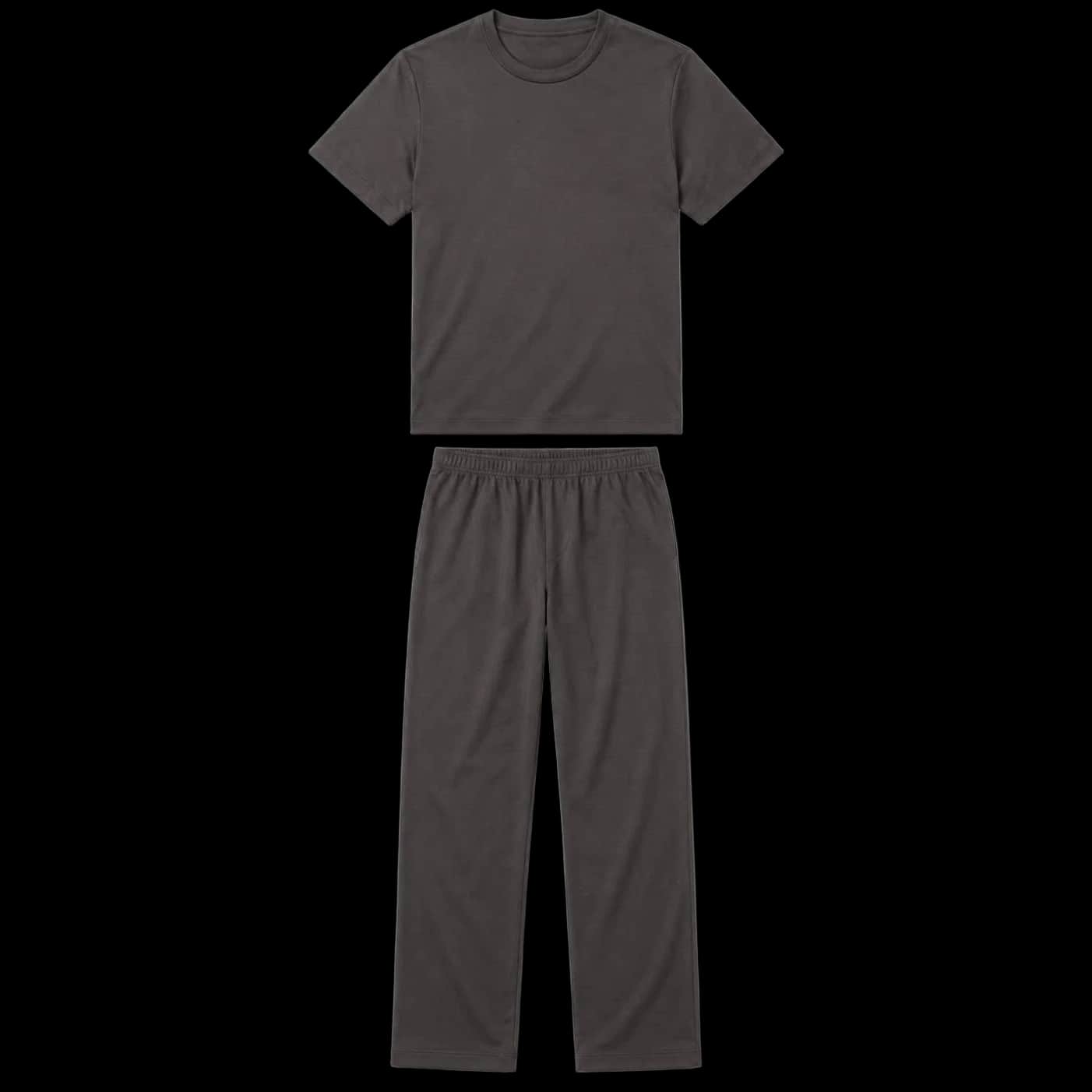
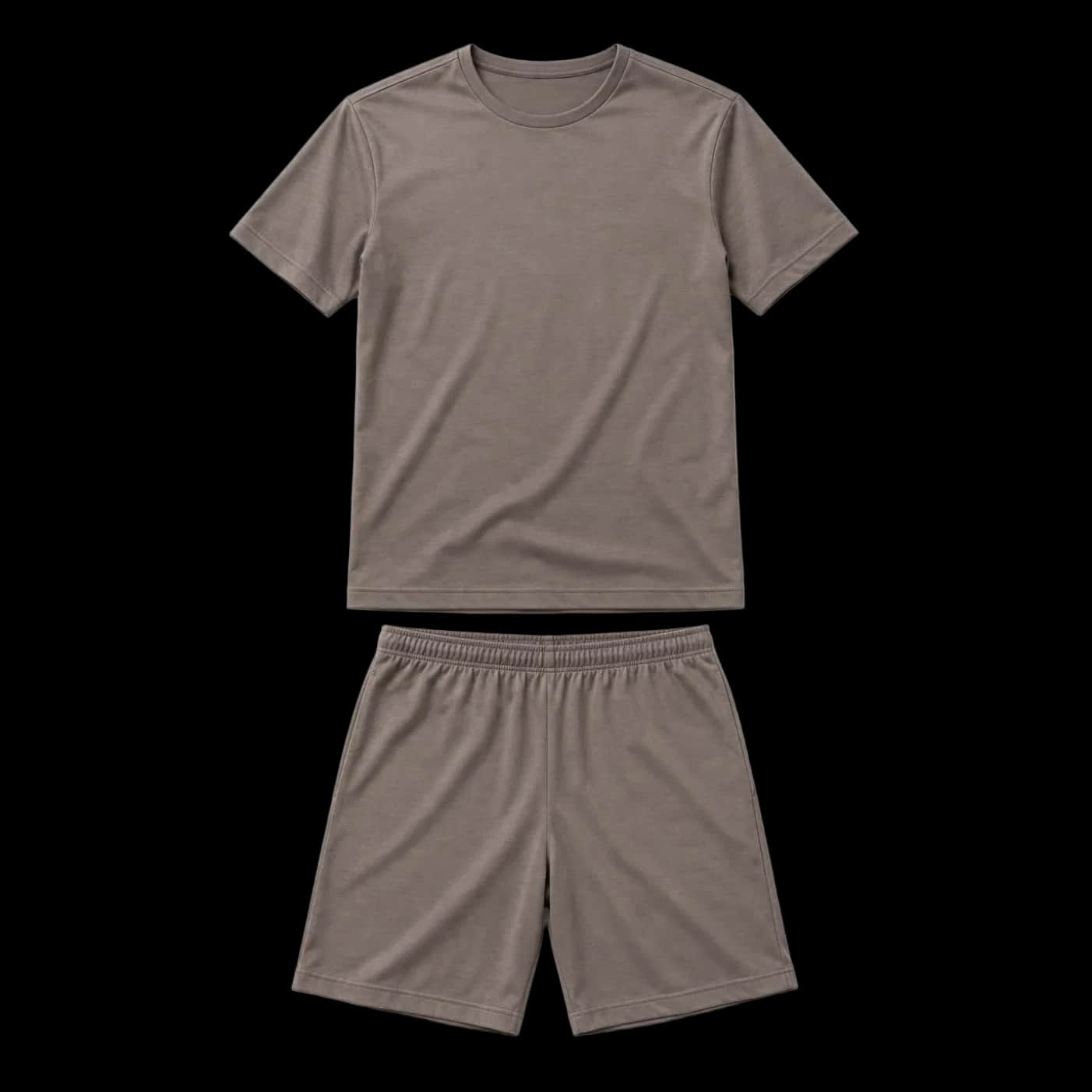
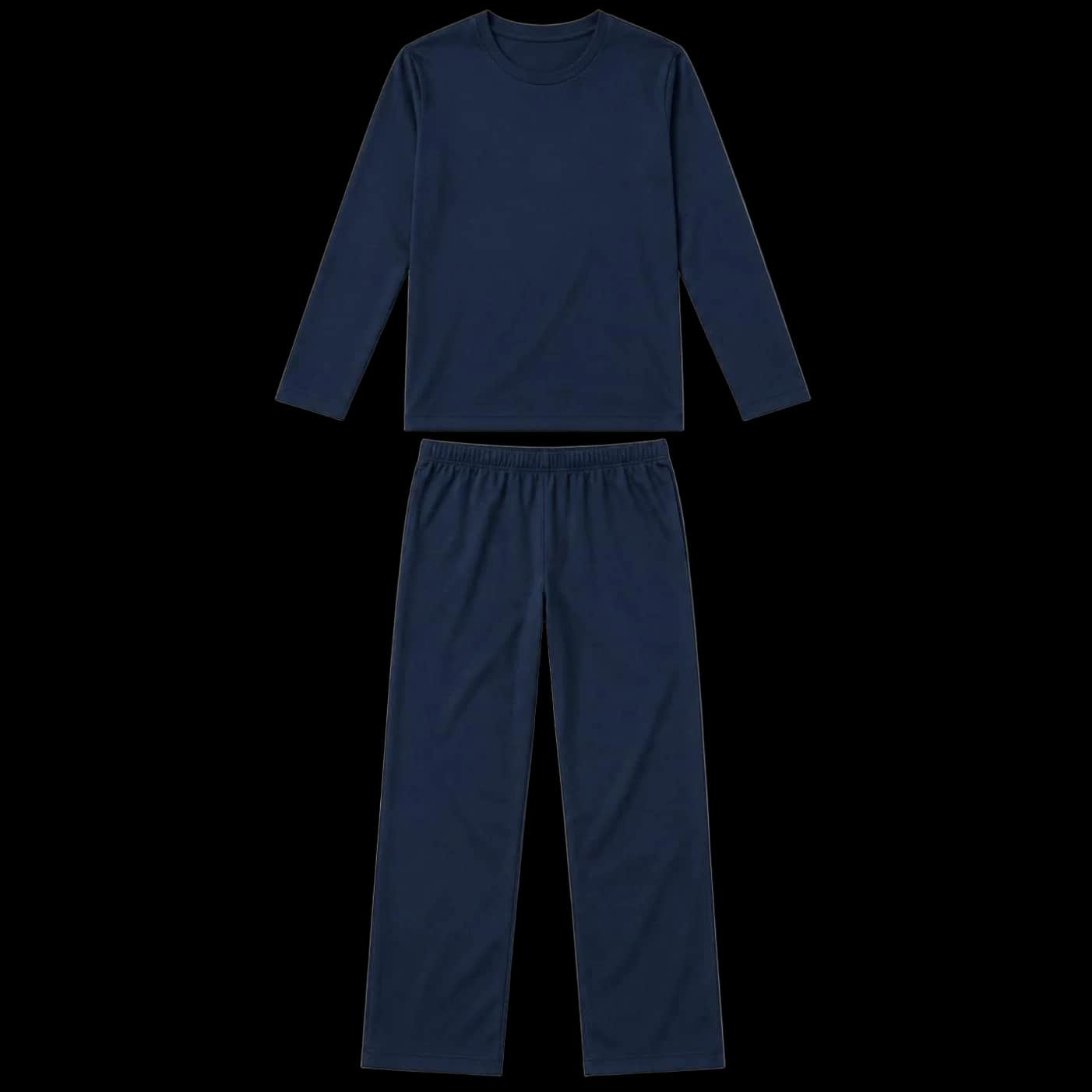
Jersey pajama sets (modal, cotton jersey) are derivable from the T-shirt (#001) and sweatpants (#004) foundation documents -- same factory, same fabric system, same CMT structure. They do not require a separate encyclopedia entry. If a creator wants to make jersey pajamas, the brief routes to the jersey factory with a coordinate dye lot requirement. The woven pajama entry covers the production logic that is genuinely distinct: brushed finishes, silk handling, piping, and woven construction.
GOTS x1.23 for organic cotton poplin, flannel, and brushed cotton. OEKO-TEX STANDARD 100 as baseline for all fabrics -- pajamas are worn against skin for extended periods. For linen: OEKO-TEX at minimum, EU Ecolabel if targeting European retail. For silk: OEKO-TEX and confirm acid-dye specification. For polyester satin: GRS x1.15-1.20 if using recycled polyester. OEKO-TEX on buttons and trims -- all components against skin.
China for all fabric routes at accessible MOQ. India for GOTS cotton poplin and block print -- strong natural-fabric and print infrastructure. Portugal for Made in Europe GOTS linen and cotton. Turkey for EU-delivery cotton poplin. Suzhou/Hangzhou (China) for silk specialist production -- this is the global silk manufacturing centre. Do not send silk to a non-specialist factory regardless of geography.
Specify pattern matching requirement explicitly on the tech pack. Apply x1.15 fabric consumption multiplier for all printed fabrics with a repeat larger than 5cm. Confirm cutting layout plan with factory before cutting begins -- the factory must lay up fabric to align pattern at side seams and centre back before cutting any panels. Pattern matching failure is the most expensive quality error in this entry: the entire fabric lot may be unusable.
HS 6207 for mens pajamas and nightwear. HS 6208 for womens pajamas and nightwear. Both cover woven fabric constructions. Jersey pajamas are classified in the same codes. The full set is typically shipped under the single HS code of the dominant piece (usually the trouser, as the higher-value item). Confirm with your customs broker -- some markets require separate classification of the shirt and trouser when sold as a set.